




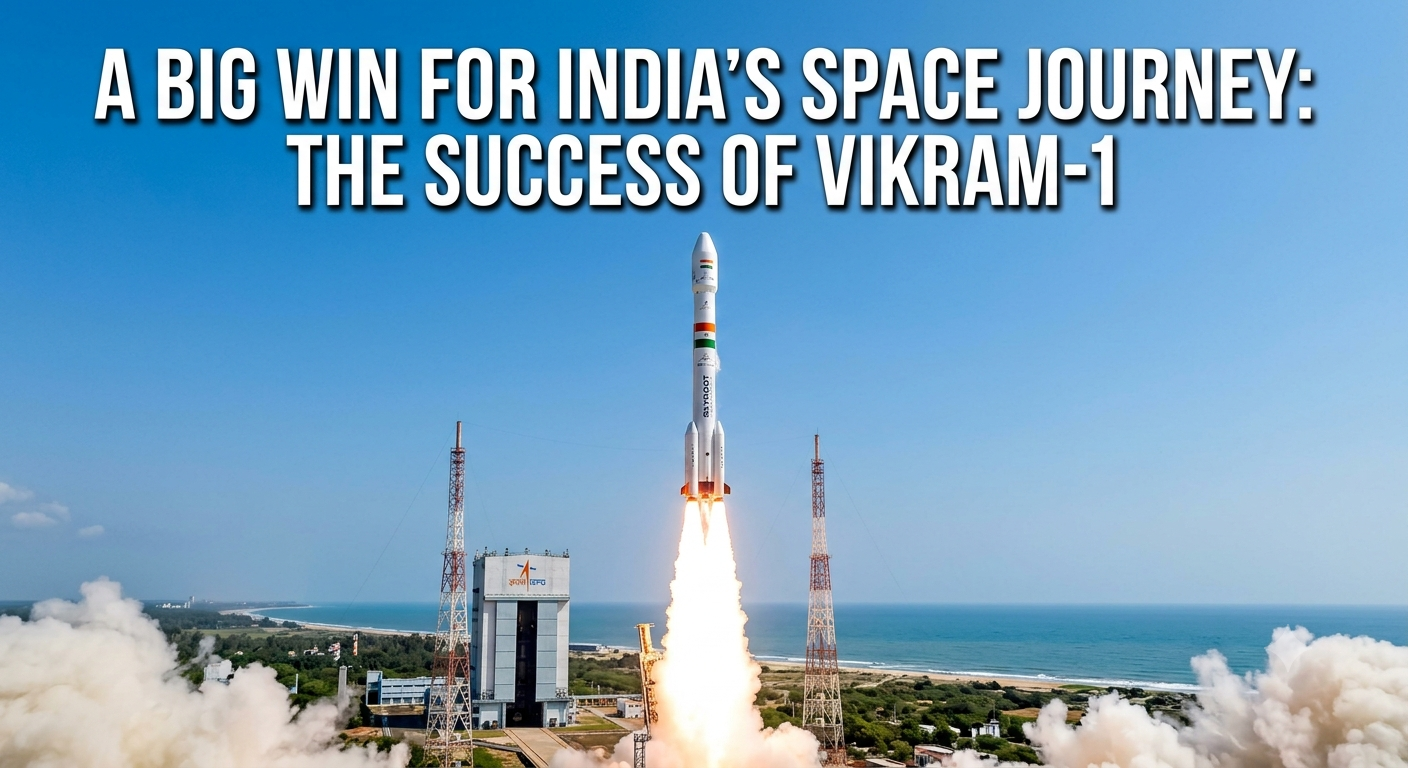
On July 18, 2026, India celebrated a major milestone in space exploration. For the very first time, a rocket built entirely by a private Indian company successfully flew into space. The rocket, named Vikram-1, safely carried and placed two satellites into orbit around the Earth.
Success on the First Try
The rocket was created by a private startup named Skyroot Aerospace. What makes this event so special is that Vikram-1 worked perfectly on its very first attempt! To understand how rare this is, famous global companies like SpaceX needed four attempts to reach orbit with their first rocket, while others like Rocket Lab took two.
Teamwork with ISRO
Skyroot did not achieve this alone. They had massive support from the Indian government and ISRO (India’s national space agency).
Shared Facilities: ISRO allowed the startup to use its world-class launch pad in Sriharikota, as well as its advanced testing centers.
Expert Guidance: ISRO shared its decades of rocket-building knowledge to help guide Skyroot’s young team.
A New Focus: Because private companies are now learning to handle regular satellite launches, ISRO can free up its time and resources to focus on bigger scientific goals, like deep-space research and exploring other planets.
Smart Technology
Going to space is incredibly difficult. A rocket must survive intense shaking, loud noises, and extreme heat. Vikram-1 used smart technology to get the job done:
Four Stages: The rocket is divided into four sections. The first three sections use solid fuel to power through the Earth’s atmosphere.
3D-Printed Engine: The fourth and final section uses a liquid-fuel engine. Liquid fuel is easier to steer and control, which helps place satellites exactly where they need to go. Amazingly, this liquid engine was largely 3D-printed and put together in just a single day!
A Bright Future for India’s Economy
The global space business is huge—currently worth around $600 billion—but India only holds a small $8 billion piece of that pie. By supporting private space companies, India hopes to grow its share to $30 billion in the coming years.
In 2014, India only had a single space startup. Today, there are around 400! The success of Vikram-1 proves that India’s young engineers and private companies are fully capable of building a bright, profitable future in the global space industry.