




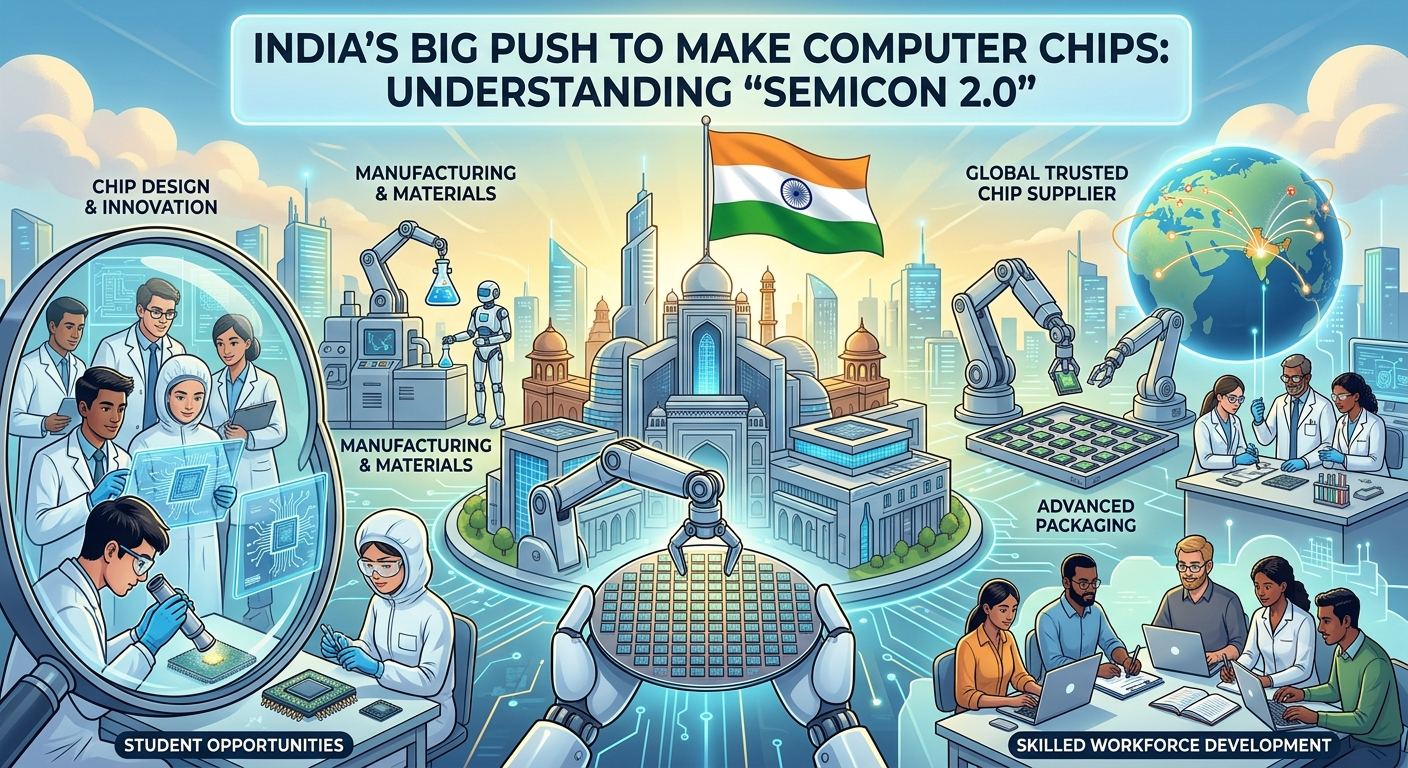
India is taking a massive step toward becoming a world leader in making computer chips (semiconductors). The government recently approved a huge new plan called “Semicon 2.0,” setting aside a budget of ₹1.27 lakh crore. This shows that India doesn’t just want to attract foreign investors anymore—it wants to build the entire chip-making process right at home.
Proving the Doubters Wrong
When India first announced its goal to make computer chips a few years ago, many people wondered if the country was truly committed. The first phase of the plan proved that it was.
The government gave the green light to 12 different manufacturing plants, and three major facilities are already starting production. On top of that, several new Indian startup companies focused on designing chips have successfully secured funding and are very close to releasing their first products.
The Six Main Goals of Semicon 2.0
To make sure the industry grows strong and stays competitive, the new plan focuses on six key areas:
Better Chip Design: The program is giving financial support to Indian companies and startups so they can design their own chips and grow their businesses to a global level.
Making the Tools and Materials: Building chips requires highly complex machines and special chemicals. The government is offering big financial rewards to companies that manufacture these tools and materials locally.
Building More Factories: After successfully helping launch a major chip factory with Tata, the government is pushing hard to attract even more large-scale manufacturing plants.
Advanced Packaging: Once a chip is made, it needs to be put into a protective package so it can be used in electronics. India wants to become a global center for this highly technical packaging process.
Research and Innovation: Sometimes foreign companies don’t want to share their most advanced technology. To fix this, India is heavily funding its own research centers to invent the next generation of chips.
Training Skilled Workers: Right now, the world is short about one million skilled chip workers. India is creating programs to train its massive workforce of engineers to fill this global gap.
Why Starting Late is Actually an Advantage
Some critics say India is too late to the chip-making race. However, experts argue that starting late is a good thing. Instead of being stuck with old, outdated factories like some other countries, India gets to build brand-new facilities using the latest, most advanced technology.
Plus, making chips in India is much more affordable. The cost of labor and electricity is significantly lower than in places like the United States or Japan, giving India a huge competitive edge.
Huge Opportunities for Students
Semicon 2.0 is heavily focused on young talent. A special program is giving students at over 320 universities access to the incredibly expensive software used to design chips. Students can actually design their own chip, have it manufactured at a government lab, and hold the physical product in their hands before they even graduate!
A Reliable Partner for the World
Recent global events like the pandemic showed how easily the supply of technology can be disrupted. Through Semicon 2.0, India isn’t just trying to become self-reliant. It is stepping up to become a safe, stable, and trusted supplier of computer chips for the entire world.