


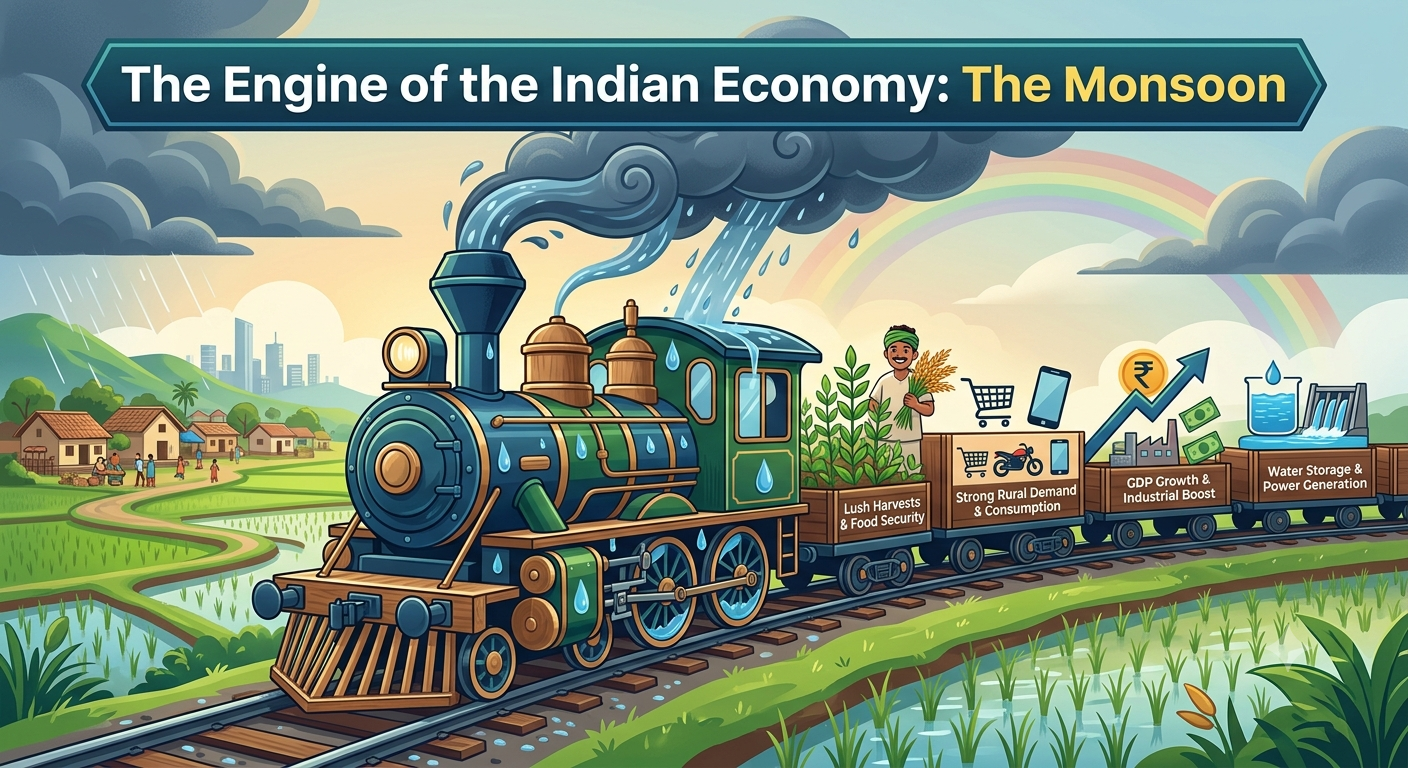
In India, rain is much more than just a change in the weather. When the monsoon arrives on time, farmers are happy, food prices stay low, and the country’s businesses grow. But when the rain is late, missing, or too heavy, it affects everyone—from the farmer in the field to the budget in your kitchen.
Here is a simple look at why the monsoon is often called the “engine” of the Indian economy.
The Lifeline of Farming
Even though India is growing fast in technology and business, farming remains the backbone of the country. Between June and September, the monsoon brings about 70% of the country’s yearly rain.
This rain is incredibly important because more than half of India’s farmland relies entirely on the sky for water. On top of that, most Indian farmers own very small pieces of land and do not have access to modern watering systems. Without good rain, important summer crops like rice, cotton, sugarcane, and pulses simply cannot grow.
Keeping Food Prices in Check
Have you ever noticed how the prices of tomatoes or onions suddenly shoot up? That usually happens when the weather goes bad.
In India, food makes up a huge part—about 40%—of our daily living costs. When there is plenty of rain, farmers grow a lot of food. This means markets are full, and prices stay cheap. But if there is a drought or a flood, crops fail, food becomes scarce, and prices skyrocket. Because rain controls food prices, even top banks like the Reserve Bank of India (RBI) watch the weather closely to predict inflation.
Boosting Business and Shopping
Villages and rural areas are home to about 65% of India’s population. When a good monsoon leads to a great harvest, farmers make good money.
When rural India has money, they spend it. They buy tractors, motorcycles, mobile phones, cement for homes, and everyday items like soap and shampoo. In fact, many companies that make daily household goods get nearly 40% of their total sales just from rural areas. So, when it rains well, factories and businesses all over the country make more money.
How the Government Helps
Because relying only on the weather is risky, the government has created several safety nets for farmers:
Crop Insurance: Programs like the PM Fasal Bima Yojana protect farmers by paying them if natural disasters or bad weather ruin their crops.
Better Watering Systems: The government spends billions to build better irrigation through schemes like the PM Krishi Sinchayee Yojana.
Saving Water: Programs like “Per Drop More Crop” teach farmers how to use less water to grow more food, protecting them during dry years.
Water for Drinking and Electricity
The monsoon does more than just grow our food. Rain fills the country’s rivers and dams. This stored water is used as drinking water for big cities and is crucial for generating electricity. India relies on this water to power large hydroelectric dams. Without good rain, the country could face both water and power shortages.
A Look to the Future
Raindrops are the true heartbeat of India’s growth. They feed the people, power the markets, and keep living costs down. However, with the climate changing and weather becoming harder to predict, we can no longer just look up at the sky and hope for the best. To protect our future, we must learn to save and store every drop of water we get today.