


The United Nations was forged in the aftermath of the Second World War with a definitive, urgent mission: to halt the cycle of catastrophic global conflicts. As famously noted by early UN leadership, the institution was never designed to construct heaven on Earth, but rather to prevent it from descending into hell. Today, however, as geopolitical tensions simmer and conflicts persist unabated, a shadow of doubt hangs over the organization’s efficacy.
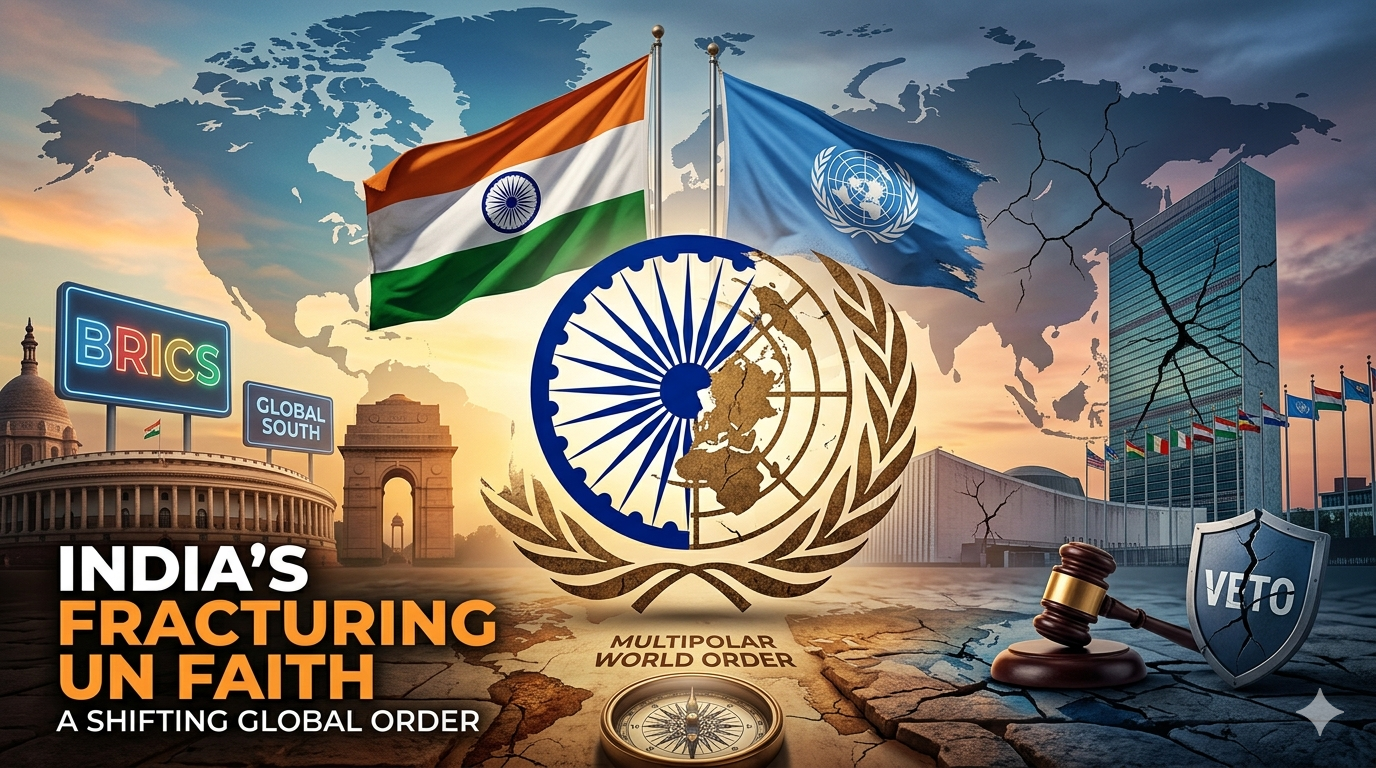
Recent diplomatic signals from New Delhi suggest a growing disillusionment. With India taking a prominent leadership role in alliances like BRICS, and major global powers hinting at the necessity of a new world order, a pressing question emerges: Is the current global architecture failing, and is India preparing to pivot away from the UN?
Echoes of the Past: The League of Nations
To fully grasp the UN’s modern challenges, it is essential to look back at its flawed predecessor, the League of Nations. Born from the ashes of World War I, the League championed the noble, yet highly idealistic, goal of collective security. It ultimately collapsed due to several critical structural vulnerabilities:
The Unanimity Paradox: Requiring absolute consensus among members paralyzed the League, making decisive interventions practically impossible.
Zero Enforcement Power: Lacking a unified military or enforcement mechanism, the League stood by helplessly during aggressive territorial expansions by nations like Italy and Japan.
Exclusionary Design: It functioned largely as a club for the victors of World War I, alienating defeated nations and laying the groundwork for further resentment.
Learning from this catastrophic failure, the architects of the UN adopted a more pragmatic approach. They vested exceptional authority in the most powerful nations of the era—the Permanent Five (P5)—granting them veto powers to ensure their continued participation and oversight.
India and the UN: A Complex Historical Tapestry
Despite being a colonized nation at the time, India was seated as a founding member of the UN in 1945. Yet, its subsequent relationship with the institution has been fraught with diplomatic hurdles and sobering geopolitical lessons.
The Kashmir Dispute (Late 1940s): When India approached the UN seeking a legal resolution against territorial incursions, the institution altered the narrative. Rather than addressing the specific invasion, the UN broadened the scope into a generalized bilateral dispute, leaving a lasting sense of diplomatic frustration in New Delhi.
The 1950 Security Council Dilemma: During the early days of the Cold War, Washington subtly suggested that India might occupy a permanent seat on the Security Council, bypassing the newly formed communist administration in Beijing. Prime Minister Nehru’s decision to decline is often debated. While framed as principled idealism, it was arguably a stroke of geopolitical realism; aligning too closely with the West could have alienated the Soviet Union, a crucial partner for India’s foundational growth and defense.
The 1971 Crisis: During the conflict that led to the creation of Bangladesh, Western powers attempted to utilize the UN Security Council to corner and sanction India. It was only the strategic use of the veto by the Soviet Union that shielded New Delhi, demonstrating how international institutions could be leveraged against India’s national interests.
The Contemporary Gridlock: An Outdated Operating System
Today, Indian diplomats frequently use a compelling metaphor to describe the UN’s inadequacy: it is akin to running a 1945 mechanical computer to govern an artificial intelligence-driven world.
The core of this paralysis lies within the Security Council itself. Whenever the international community attempts to address major modern conflicts, the system inevitably stalls. The P5 nations consistently deploy their veto powers to shield their own geopolitical maneuvers or those of their strategic allies. Because reforming this structure requires the unanimous consent of the very powers benefiting from the status quo, the system is fundamentally trapped in a deadlock.
Institutional Strain: Beyond diplomatic gridlock, the UN is grappling with a severe financial and operational crisis. Top leadership has openly acknowledged funding shortfalls that severely hamper humanitarian and developmental missions across vulnerable global regions.
The Path Forward: Reform or Replace?
The post-war multilateral framework, traditionally upheld by Western powers, is showing visible signs of decay. As historical power centers pull back funding and retreat from international agreements to protect their own dominance, the Global South is actively seeking alternatives.
Platforms like BRICS are rapidly gaining traction as viable counterweights. As these coalitions expand to represent a massive portion of the global population and economic output, they are laying the groundwork for alternative financial and governance structures that operate independently of Western-dominated institutions.
However, completely abandoning the United Nations is a drastic measure. International relations experts widely agree that a centralized global forum is an absolute necessity to prevent sheer anarchy. If the current UN were to be dissolved today, the international community would immediately be forced to invent a replica to manage diplomatic relations and basic global rules.
While a sudden exit is unlikely, India’s strategic investments in alternative multilateral frameworks clearly signal a profound shift. The world is transitioning into a multipolar reality, and nations of the Global South are positioning themselves to dictate the terms of the next era of global governance.