



Chaired by India’s External Affairs Minister, Dr. S. Jaishankar, the recent Quad summit marked a transition toward actionable geopolitical strategies aimed at preserving a free and stable Indo-Pacific.
1. Advancing Maritime Domain Awareness
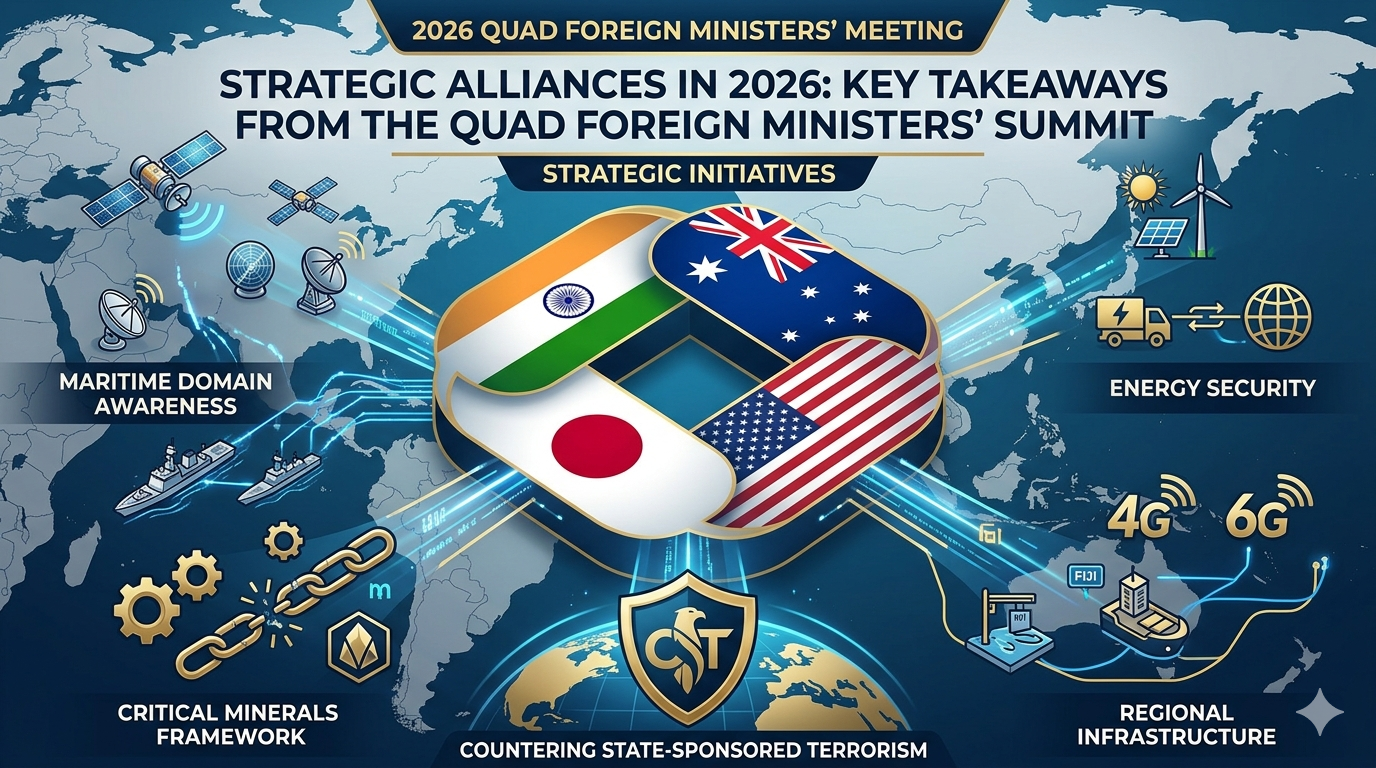
A cornerstone of the summit was the introduction of the Indo-Pacific Maritime Surveillance Collaboration (IPMSC).
- The Objective: The initiative seeks to establish a unified operational view of the region’s waters. By integrating surveillance capabilities, member nations can monitor both civilian commercial ships and naval vessel traffic with real-time precision.
- Geopolitical Significance: As naval presence intensifies in the region, this collaborative tracking shifts the Quad from a purely civilian infrastructure focus toward active intelligence sharing, thereby safeguarding critical maritime trade routes.
2. Securing the Future: Critical Minerals Framework
To combat economic pressures and monopolistic practices, the member states introduced a new framework for critical minerals.
- The Challenge: The global supply of rare earth elements—which are vital for defense manufacturing and modern electronics—is heavily concentrated. This centralization has often been utilized as leverage during geopolitical disputes.
- The Solution: By pooling investments and potentially partnering with resource-abundant nations in the wider region, the Quad intends to decentralize the extraction and processing of these minerals. The ultimate goal is to create a resilient, independent supply network that cannot be easily disrupted.
3. Building Energy Resilience
The volatility of global energy markets prompted the Quad to prioritize energy security as a core national defense issue, rather than just an economic one.
- Strategic Diversification: The alliance aims to insulate the Indo-Pacific from supply shocks caused by international conflicts by diversifying energy sources and reducing reliance on traditional, dominant suppliers.
- Infrastructure Investment: This transition will require collaborative investments in logistics and technological advancements to foster a stabilized, competitive energy marketplace.
4. Transitioning from Theory to Actionable Infrastructure
Moving past diplomatic rhetoric, the 2026 meeting heavily emphasized concrete, verifiable projects.
- Tangible Developments: The alliance committed to accelerating the rollout of regional 4G and 6G networks, executing undersea communication cables in Pacific Island nations by the end of 2026, and developing crucial port facilities in Fiji.
- Regional Impact: Executing these physical projects reinforces the Quad’s reputation as a reliable development partner that delivers on its promises, rather than serving merely as a strategic talking shop.
5. A Unified Stance on Regional Security
The evolving landscape of non-state threats, including the deployment of advanced drone technology, was addressed with a strong, collective voice. The foreign ministers explicitly condemned state-sponsored terrorism. This reflects a shared commitment by nations that have historically suffered from extremist attacks to combat radicalization and secure their borders against emerging tactical threats.
The Road Ahead
The 11th Quad meeting underscored a reinvigorated, highly practical approach to global governance. By focusing on maritime intelligence, supply chain independence, and physical infrastructure, the member nations are actively shaping the strategic and economic future of the Indo-Pacific.