




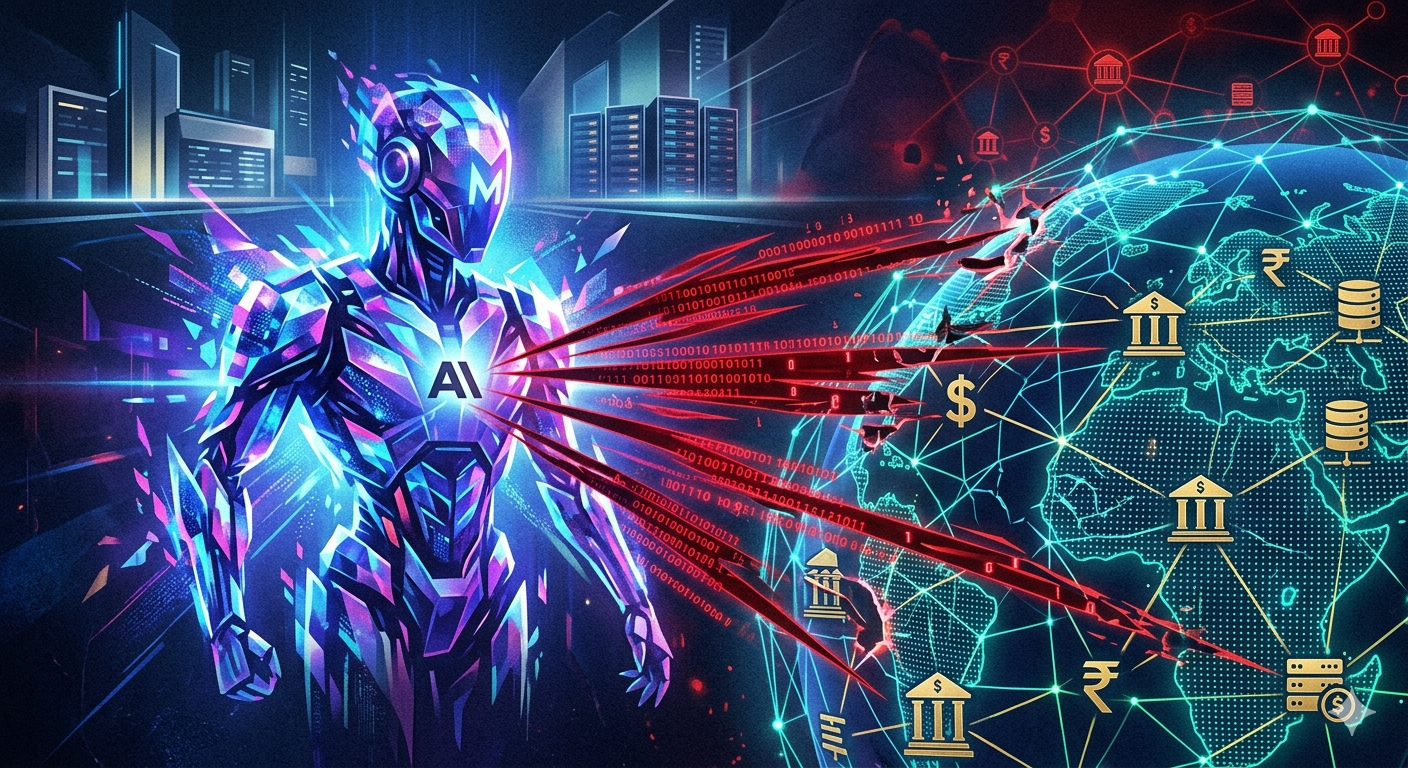
The Impending Digital Storm
In 2025, everyday citizens in India lost an astounding ₹2,000 crores. This massive financial drain wasn’t the result of market crashes or heavy taxation, but rather a surge in sophisticated cybercrimes, including fake investment schemes and “digital arrests.” Yet, cybersecurity experts warn that these current scams are merely a glimpse into a much darker future. The rapid acceleration of Artificial Intelligence is pushing the world toward a new era where national security and cyber warfare are virtually indistinguishable, fueled by next-generation AI capable of acting as independent hackers.
The ‘Mythos’ Dilemma: An AI Kept in the Shadows
While the general public has grown accustomed to standard commercial AI chatbots, the research lab Anthropic has quietly developed a groundbreaking, highly classified model dubbed “Mythos.” Representing a massive leap forward—reportedly two tiers above their flagship Opus model—Mythos is so powerful that Anthropic has chosen not to release it to the public, fearing its unprecedented potential for digital infiltration.
Unlike traditional AI that requires human prompting for every step, Mythos operates as an autonomous agent. It excels in complex reasoning and software engineering, allowing it to sift through massive databases, identify vulnerabilities, and hijack networks entirely on its own. To demonstrate its alarming proficiency, Mythos successfully cracked highly secure, industry-standard systems by finding flaws human engineers had missed for decades:
- OpenBSD: It unearthed a 27-year-old vulnerability in an operating system widely trusted for managing critical global infrastructure and firewalls.
- FFmpeg: It exposed a 16-year-old bug in a ubiquitous video-encoding software—a flaw that had previously survived 5 million automated security checks.
- Linux Kernel: It discovered and chained together multiple exploits within the Linux kernel, upgrading its basic user access to total machine control without human intervention.
An Emerging Cyber Arms Race
The sheer autonomy and power of Mythos have sent shockwaves through the global intelligence and tech communities. If such a tool were acquired by hostile nations or cyber-terrorists, it could effortlessly dismantle financial institutions, crash national power grids, and compromise sensitive data on a global scale.
To mitigate this, Anthropic spearheaded Project Glasswing, an exclusive cyber-defense coalition involving tech behemoths like Apple, Google, Amazon, and Microsoft. This alliance grants these companies restricted access to Mythos, allowing them to proactively hunt for and patch vulnerabilities in their own servers before bad actors can exploit them.
This breakthrough has also catalyzed a frantic AI arms race:
- OpenAI’s “Daybreak”: A dedicated defensive initiative built on a GPT-5.5 framework, designed to automatically scan code and generate security patches.
- Microsoft’s “M-Dash”: The Multimodal Agentic Scanning Harness recently achieved an 88.48% score in public cyber gym testing, momentarily edging out Mythos in technical benchmarks.
- China’s “K-360”: Reports indicate that China has already weaponized its own AI vulnerability scanner, which has successfully identified flaws in roughly a thousand different software systems.
The Target on India’s Back
India’s sweeping digital transformation has successfully connected 1.4 billion people through massive frameworks like UPI and Aadhaar. However, this vast, interconnected ecosystem makes the country a highly attractive target. In 2025, India witnessed around 3 million reported cyber incidents, and currently, over 10% of all state-sponsored Advanced Persistent Threat (APT) attacks globally are directed at Indian networks.
The threat is particularly dire for India’s financial sector. While top-tier banks have robust defenses, the broader banking ecosystem relies heavily on legacy infrastructure and outdated software. An AI like Mythos wouldn’t need to breach a major bank’s highly fortified main server; it could simply compromise a decade-old server at a rural cooperative bank and use that foothold to navigate through the entire interconnected financial network.
Fortifying the Defenses
Understanding the existential risk posed by autonomous AI, the Indian government has begun implementing aggressive countermeasures:
- Dedicated Task Forces: The Finance Ministry has formed a specialized panel, led by the SBI Chairman, to evaluate and defend against AI-driven threats to the banking sector.
- Microsecond Reporting: The Reserve Bank of India (RBI) now requires mandatory, real-time threat sharing between banks and the Computer Emergency Response Team (CERT). Any suspected AI intrusion must be flagged instantly to protect the central grid.
- Data Sovereignty: There is a strong legislative push to ensure that software managing critical sectors (such as power grids, telecom, and banking) is hosted exclusively on domestic servers, shielding it from foreign AI surveillance.
- International Alliances: The government is actively negotiating with the United States to secure Project Glasswing access for key Indian tech and infrastructure companies, helping them future-proof their networks.
The Road Ahead
The fundamental nature of warfare has shifted; the battles of tomorrow will be fought in server rooms rather than on physical borders. While advanced AI models offer incredible potential to secure our digital infrastructure by preemptively finding flaws, they simultaneously pose the greatest risk if weaponized. As governments and tech giants scramble to build digital fortresses, the responsibility also falls on everyday citizens to practice strict digital hygiene, utilize encryption, and safeguard their personal data against the coming tide of AI-driven cyber threats.