




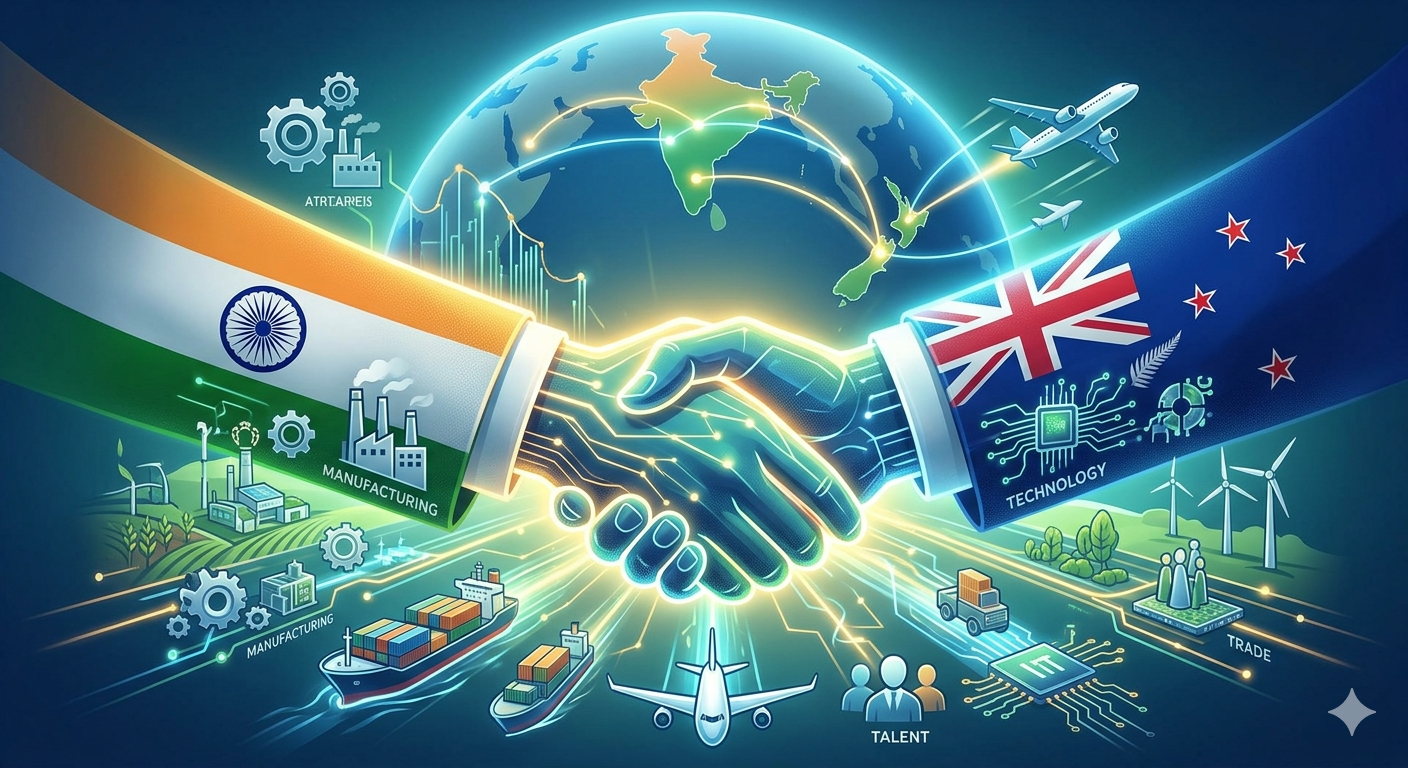
After more than ten years of diplomatic dialogue, India and New Zealand have officially cemented a landmark Free Trade Agreement (FTA). Broadly recognized by economic analysts as a generational milestone, this pact extends far beyond the traditional boundaries of tariff reductions. Instead, it serves as a robust framework designed to integrate with India’s long-term economic aspirations and its expanding footprint in the Indo-Pacific region.
Here is a closer look at why this bilateral agreement is being hailed as a major breakthrough for both nations.
The Rise of Bilateral Diplomacy
In the wake of recent global disruptions—ranging from the pandemic to ongoing geopolitical conflicts in Europe and the Middle East—traditional multilateral trade models are losing their edge. Global supply chains have faced unprecedented unpredictability, prompting nations to rethink their economic alliances.
As a result, India has actively pivoted toward securing strong, country-to-country partnerships. Following successful agreements with the UAE, Australia, and European markets, the New Zealand FTA stands out as the latest testament to India’s confident, proactive approach to global trade. Rather than chasing short-term tariff benefits, this strategy prioritizes long-term economic transformation.
Securing the Supply Chain: The “China Plus One” Advantage
At the heart of this agreement is a strategic vision that addresses modern global supply chain vulnerabilities. As international markets look to reduce their heavy reliance on a single manufacturing dominant like China (a strategy often termed “China Plus One”), India is stepping up as a highly reliable and capable alternative.
Trade experts note that the core of this FTA is deeply rooted in comprehensive economic cooperation. It is designed to facilitate technology transfer, skill development, and resilient manufacturing networks across the Indo-Pacific, ensuring that both nations can weather future global economic shocks.
Key Economic Windfalls
The tangible economic benefits of the deal are substantial, particularly for India’s domestic markets and workforce:
A Boost for Domestic Manufacturing: Nearly 100% of Indian exports will eventually enjoy duty-free access to New Zealand. This is a massive win for India’s Micro, Small, and Medium Enterprises (MSMEs), particularly in labor-intensive sectors like textiles, pharmaceuticals, leather, and IT services.
Capital and Technological Growth: The agreement paves the way for an estimated $20 billion in investments over the next 15 years. This influx is expected to drive large-scale job creation, nurture startup ecosystems, and modernize local industries.
Global Talent Mobility: Recognizing the value of human capital, the agreement includes provisions for 5,000 specific visas. This will allow highly skilled Indian professionals in fields such as engineering, healthcare, and technology to access new opportunities in New Zealand, fostering a deeper cultural and professional exchange.
Shielding Vulnerable Sectors
A hallmark of a well-negotiated trade deal is the balance between opening markets and protecting domestic interests. The India-New Zealand FTA manages this delicate act effectively.
To prevent local producers from being sidelined by highly advanced international competitors, India has kept several sensitive sectors—most notably dairy, edible oils, and sugar—out of the agreement. New Zealand has a highly advanced dairy and agricultural infrastructure; by keeping these sectors protected, India ensures its local farmers and emerging agricultural markets are not overwhelmed, allowing them time to grow and adopt new practices at their own pace.
Looking Ahead
Ultimately, the India-New Zealand Free Trade Agreement is much more than a ledger of import and export duties. It is a strategic alignment of two nations looking to build a resilient, shared future. By prioritizing skill development, protecting local farmers, and opening up global avenues for Indian MSMEs, this partnership serves as a vital engine for India’s vision of becoming a fully developed, integrated global economy in the coming decades.