


An analytical look at the upcoming 2026 delimitation process, the risk of a North-South political divide, and the future of India’s federal structure.
India is approaching a critical juncture in its democratic journey. With the looming expiration of the freeze on parliamentary seat allocation in 2026, the country faces a complex legislative transition. The central government is expected to expand the capacity of the Lok Sabha (the lower house of Parliament) from its current 543 seats to potentially over 800.
While the immediate catalyst for this expansion is often cited as the need to accommodate the recently passed Women’s Reservation Bill, the underlying process—known as delimitation—has sparked a profound debate over fairness, federalism, and the balance of power in India.
The Core Issue: The Demographic Divide
Delimitation is the routine democratic process of redrawing electoral boundaries to ensure that each lawmaker represents roughly the same number of citizens. This upholds the fundamental principle of “one person, one vote.”
However, applying this principle strictly by current population metrics poses a unique challenge in India due to stark regional disparities:
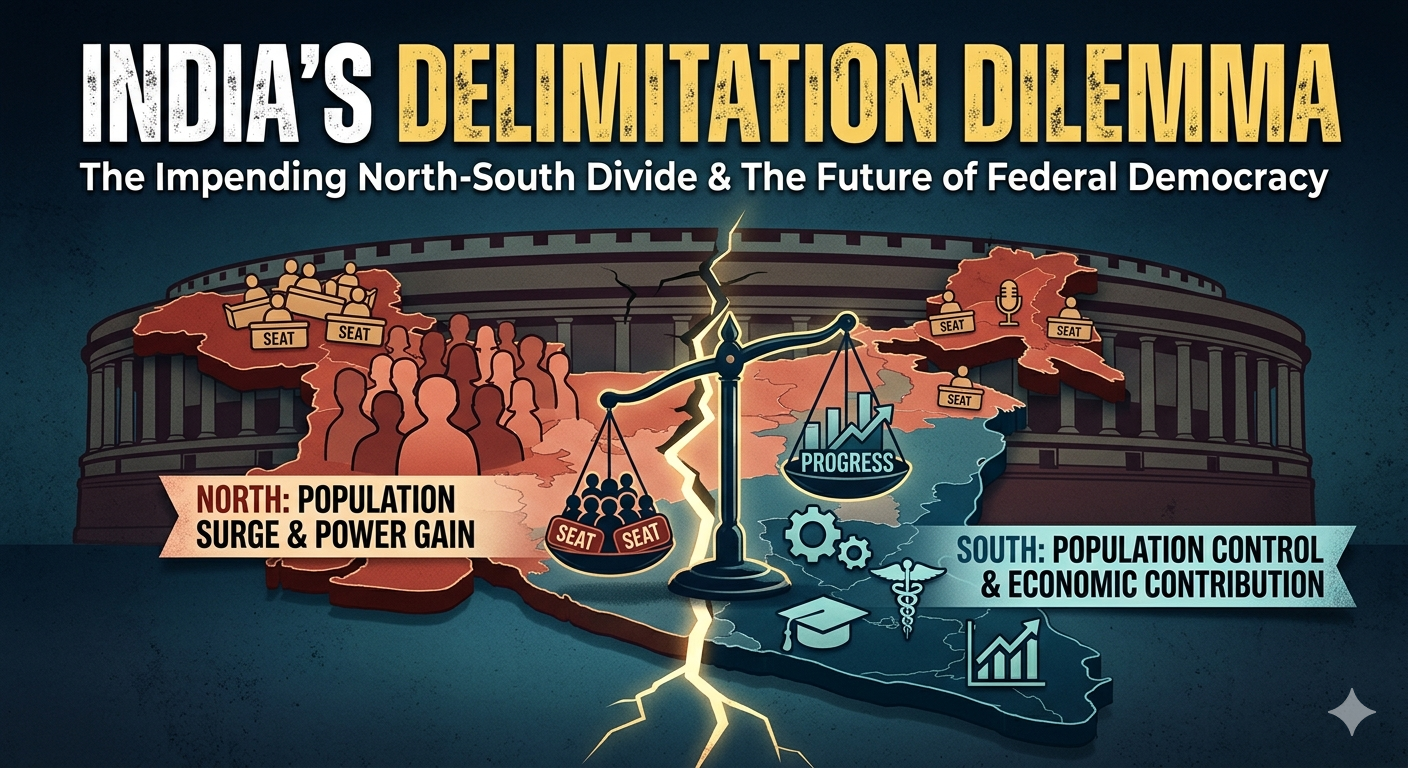
The Southern Success: Over the past few decades, Southern states (such as Kerala, Tamil Nadu, Andhra Pradesh, Telangana, and Karnataka) have successfully prioritized family planning, stabilizing their populations while significantly boosting their economic output and human development indices.
The Northern Boom: Conversely, heavily populated states in the Hindi heartland (such as Uttar Pradesh, Bihar, and Rajasthan) have experienced massive population growth over the same period.
If the upcoming delimitation relies solely on recent census data, the political weight of the Southern states will proportionally shrink, while the Northern states will see a massive surge in their parliamentary representation. Critics argue this creates a paradox where states are effectively penalized politically for successfully executing national population control and development policies.
Historical Context: Why Was Delimitation Frozen?
The disparity we see today is not a new realization. Historically, seat allocations were updated after every census. However, recognizing the uneven population growth across the country, the government intervened:
1976 Freeze: During the Emergency, the Indira Gandhi administration froze the allocation of Lok Sabha seats based on the 1971 census. The goal was to encourage all states to aggressively pursue family planning without the fear of losing their political voice in Parliament.
2001 Extension: Realizing that population growth had not yet stabilized uniformly, the Atal Bihari Vajpayee government extended this freeze for another 25 years, setting the expiration for 2026.
The 50-year window intended to equalize demographic growth has passed, but the imbalance remains, bringing the delimitation debate back to the forefront.
The Political Strategy and Implications
The legislative maneuvering around delimitation presents a complex challenge for political opposition. By linking the necessary expansion of parliamentary seats to the implementation of the widely supported Women’s Reservation Bill, any resistance to the delimitation process can easily be framed as opposition to women’s political empowerment.
Should the reapportionment go through based purely on population, the political center of gravity will shift permanently. National parties with strong footholds in the densely populated North will be able to secure national majorities with little to no reliance on the electoral outcomes in the South or East.
Proposed Avenues for a Fair Transition
To preserve the federal fabric of the country and ensure equitable representation, constitutional experts and regional leaders have proposed several alternatives to a purely population-based delimitation:
Proportional Seat Increases: Instead of reapportioning based on absolute population, the total number of seats could be increased while maintaining the current percentage share of each state. This allows for a larger Parliament to accommodate women’s reservations without altering the regional balance of power.
Factoring in Economic Contribution: Representation could be calculated using a weighted formula that considers both population size and a state’s economic performance (GDP) or progress in human development.
Empowering the Upper House: To offset the demographic dominance of the Lok Sabha, the Rajya Sabha (Council of States) could be reformed. Taking a cue from the U.S. Senate, India could assign an equal number of Rajya Sabha seats to every state, regardless of its population size, ensuring that smaller or less populous states maintain a powerful voice in national legislation.
Looking Ahead
The unfreezing of delimitation in 2026 is more than an administrative update; it is a test of India’s cooperative federalism. Navigating this transition will require widespread political consensus, transparent public consultation, and a willingness to look beyond immediate electoral gains. If handled poorly, it risks alienating entire regions of the country; if handled with nuance, it could modernize Indian democracy for the coming century.